International Cooperation
International Collaboration
Since 2019, I have been teaching “the invisible part of the job” in the documentary film programs at the TV School at the University of Innlandet in Norway. This has taken place in close collaboration with Associate Professor Mette Nyseter, who researches how role-playing can be used as a method in artistic and pedagogical development within television and documentary film production.
The goal is for role-playing and a more body-based approach to teaching—“Embodied Learning”—to deepen students’ understanding of themselves as documentary filmmakers and to enhance the quality of their skills and artistic productions. Over the years, we have developed and tested a wide range of specific exercises based on role-playing, embodied learning, and the simulation of reality.
Read more
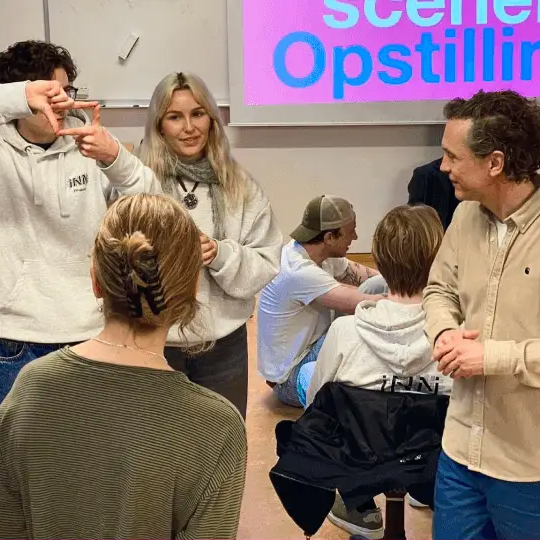
Photo: Mette Nyseter / Universitetet i Innlandet
EMBODIED LEARNING
In 2025, we entered into a development partnership with FAMU—the Film and TV School of the Academy of Performing Arts in Prague—which also conducts research and teaching in role-playing and embodied learning as a pedagogical method. This initiative is led by instructor Tereza Reichová.
As a representative of the National Film School of Denmark, this Norwegian-Danish-Czech collaboration represents a new learning initiative. Through embodied learning, the initiative focuses on documentary filmmakers using their entire “selves” to acquire new knowledge: knowledge about their own patterns and professional roles, knowledge about the project they are working on, as well as knowledge about collaboration and managing contributors. In short, new knowledge about one’s own methodology, grounded in the body, action, and experience.
In June 2026, we will present our work at The Second International Conference on Embodied Education in Copenhagen.
READ MORE
Role-playing is not, in itself, a new method and is used, for example, in nursing, negotiation techniques, law school, and other fields.
It may seem surprising that it isn’t more widely integrated into our professional world, given that it specifically trains creativity, social skills, and the ability to handle unpredictability—three cornerstones of the work involved in creating documentary narratives.