
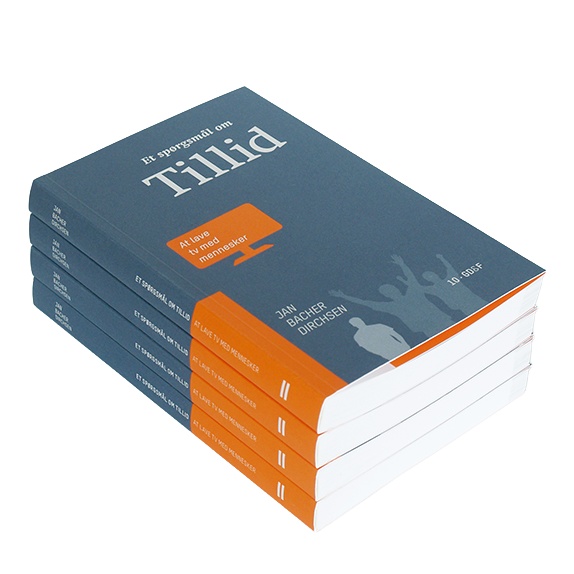
A matter of trust – making television with people
Expected to be published in English in 2027
Working title: Beyond the Frame
Navigating Trust and Relationships in TV and Documentary Filmmaking
The only textbook on the market that delves deep into the fundamental yet often overlooked aspect of the work involved in creating stories with and about other people – namely, the relationship between the professionals behind the camera and the participants in front of it.
- How can you best look after your cast?
- How can you look after yourself better?
- The relationship with the cast is crucial to the quality of the story you want to tell
A MATTER OF TRUST – MAKING TELEVISION WITH PEOPLE
The way participants are managed is left too much to the individual to figure out, and this book changes that.
Using examples, his own mistakes and reflective questions, Jan Bacher Dirchsen draws on his background as a psychotherapist and 25 years’ experience as a documentary director, TV presenter and producer to make the invisible work of building relationships tangible and accessible.
A Matter of Trust – Making Television with People is divided into chapters corresponding to the various phases of a production and can therefore be read as a whole or used as a reference work.
As well as being aimed directly at documentary directors and TV producers, A Matter of Trust – Making TV with People is useful for everyone on a production team: producers, assistant directors, cameramen, researchers, casting directors and others.
The book A Matter of Trust – Making Television with People is also relevant to other professional groups where establishing ‘professional trust’ is part of the job.
The second edition was published in 2019.
A textbook example of educational communication.
Jan Bacher Dirchsen’s reflections on how, as a professional, one can enter people’s private lives without leaving filthy, permanent fingerprints everywhere are subtle, nuanced and thought-provoking, both for documentary programme makers and for viewers…
Recommendations
What makes the book Trust – Making TV with People unique is that it so clearly demonstrates how crucial the relationship between the participants and the production team is to the end result seen on screen.
He describes dilemmas, ethical issues and success factors that apply to all documentary-makers, regardless of genre or format.
The fact that Jan himself is a professional psychotherapist, director and producer lends an extra dimension and weight to the insights he conveys.
Since 2019, this book has been on the syllabus for our students at the TV School in Lillehammer, and it has proved to be one of the most important core textbooks in our Bachelor’s programme in Documentary and TV Directing at the University of Innlandet.
I can wholeheartedly recommend this book.
I became aware of Jan Dirchsen’s book because so many of my drama students at the TV school in Lillehammer quoted from it in their exam papers.
When I read it myself, I was impressed by how Dirchsen draws on his own recognisable experiences to offer practical advice on how to gain trust, but also by how he encourages and promotes ethical reflection on how to uphold that trust.
This makes the book a valuable resource for both students and more experienced documentary filmmakers.
Jan Dirchsen’s book has been instrumental in highlighting a fundamental principle of documentary practice: trust and the professional treatment of those who take part in documentary and other productions.
Before Jan’s book, this topic was rarely discussed openly or professionally. The book changed that.
It is widely read by students of media and related subjects and has become the industry’s go-to book.
I can highly recommend "Trust".
I have used Jan’s book as part of my course at DMJX, where I am studying Media Production.
The book was part of the syllabus and was distributed to all students. Incidentally, it is the only literature I have been able to find in this field.
It is a book that exemplarily manages to provide a framework for working with people on video – something that, as a starting point, is completely abstract and elusive.
It is one thing to achieve what a production sets out to do, but quite another to engage the human element…
It is hands-on – and delivers what it promises: descriptions of all the complexities involved in audiovisual productions featuring people.